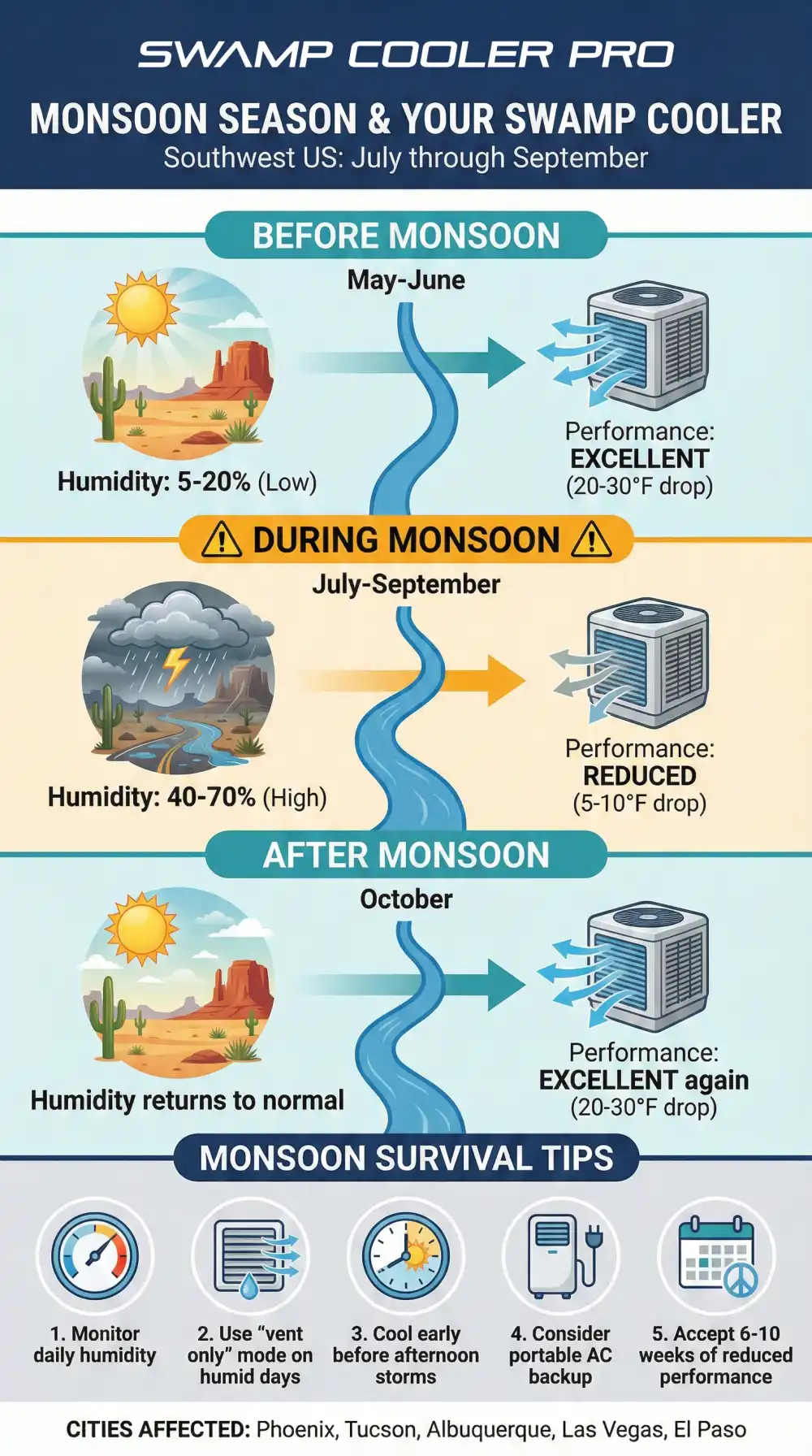
Yes, monsoon season significantly impacts evaporative cooler performance in the Southwest. During the North American Monsoon (typically July through September), humidity levels can spike from typical lows of 10-20% to 40-60% or higher.
How monsoon affects cooling:
- Before monsoon (May-June): Humidity often 5-20%. Excellent evaporative cooling—20-30°F temperature drops possible.
- During monsoon (July-September): Humidity spikes to 40-70%. Evaporative cooling effectiveness drops dramatically. You may only get 5-10°F of cooling on humid days.
- After monsoon (October): Humidity returns to normal. Evaporative cooling works well again.
Strategies for monsoon season:
1. Monitor humidity - Check your local weather. On days below 40% humidity, your cooler will still work reasonably well.
2. Use "vent only" mode - Run the fan without water to circulate air when it's too humid for evaporative cooling.
3. Supplement with portable AC - Some homeowners keep a portable or window AC unit for the worst monsoon days.
4. Cool early - Run your cooler in the morning before afternoon thunderstorms raise humidity.
5. Accept reduced performance - On humid monsoon days, your cooler won't make your home as cool as usual.
Cities most affected by monsoon:
- Phoenix, Tucson, and southern Arizona
- Albuquerque and New Mexico
- Las Vegas (to a lesser extent)
- El Paso and West Texas
The monsoon period is typically 6-10 weeks. Most evaporative cooler owners simply tolerate reduced performance during this time, as the energy savings during the rest of summer still make evaporative cooling worthwhile.